Tuesday, 30 April 2019

Yang, Jenny Chan and Xu Lizhi (2019) La máquina es tu amo y señor (Virus Editorial)


Yang, Jenny Chan and Xu Lizhi. 2019. La máquina es tu amo y señor (The Machine is Your Lord and Master). Translated in Spanish by Li Fei and Zhang Xiaoqio. Barcelona: Virus Editorial.


Una oleada de suicidios durante el año 2010 en la ciudad-fábrica de Foxconn, en Shenzhen, sacó a la luz las condiciones infrahumanas en las que vive y trabaja su plantilla laboral, formada en su mayoría por jóvenes y migrantes, llegados de diferentes regiones rurales de China.

Esta empresa es la mayor fabricante mundial de componentes electrónicos y da servicio a compañías como Apple, Amazon o Google. El cándido discurso de Silicon Valley —«el sentimiento de construir un mundo mejor gracias a la tecnología»— contrasta con las condiciones neoesclavistas que padecen las y los trabajadores de Foxconn, basadas en un taylorismo extremo y en una disciplina y vigilancia militarizadas, dentro y fuera de la cadena de montaje.

Este libro recoge los testimonios de Yang, un estudiante y obrero industrial; Tian Yu, trabajadora migrante que sobrevivió a un intento de suicidio; y Xu Lizhi, que antes de poner fin a sus días dejó escritas descarnadas poesías que nos adentran en las fauces del sistema de Foxconn. Estos poemas, como el resto de textos, cuestionan el beneficio tecnológico, desde ese «otro lado del mundo», en relación con el coste humano, ecológico y social que entraña.

«Hemos perdido el valor que nos corresponde como seres humanos y nos hemos convertido en una extensión de las máquinas, su apéndice, sí, su esclavo. Muchas veces pensaba que la máquina era mi amo y señor, cuyo cabello tenía que peinar como un esclavo.»

Michele Ford (2019) From Migrant to Worker (Cornell ILR Press)


Michele Ford. 2019. From Migrant to Worker: Global Unions and Temporary Labor Migration in Asia. Ithaca: Cornell ILR Press.

What happens when local unions begin to advocate for the rights of temporary migrant workers, asks Michele Ford in her sweeping study of seven Asian countries? Until recently unions in Hong Kong, Japan, Malaysia, Singapore, South Korea, Taiwan, and Thailand were uniformly hostile towards foreign workers, but Ford deftly shows how times and attitudes have begun to change. Now, she argues, NGOs and the Global Union Federations are encouraging local unions to represent and advocate for these peripheral workers, and in some cases succeeding.
From Migrant to Worker builds our understanding of the role the international labor movement and local unions have had in developing a movement for migrant workers' labor rights. Ford examines the relationship between different kinds of labor movement actors and the constraints imposed on those actors by resource flows, contingency, and local context. Her conclusions show that in countries—Hong Kong, Malaysia, and Thailand—where resource flows and local factors give the Global Union Federations more influence local unions have become much more engaged with migrant workers. But in countries—Japan and Taiwan, for example—where they have little effect there has been little progress. While much has changed, Ford forces us to see that labor migration in Asia is still fraught with complications and hardships, and that local unions are not always able or willing to act.

Indian Perspectives on Workplace Bullying (2018) D’Cruz, Noronha, Mendonca and Mishr, eds (Springer Nature)


Premilla D’Cruz, Ernesto Noronha, Avina Mendonca and Nidhi Mishra, eds. 2018. Indian Perspectives on Workplace Bullying: A Decade of Insights. Singapore: Springer Nature. 


https://www.springer.com/us/book/9789811310164#aboutAuthors

cover

Sunday, 31 March 2019

Jörg Nowak (2019) Mass Strikes and Social Movements in Brazil and India (Palgrave Macmillan)


“Jörg Nowak has written an ambitious, wide-ranging and very important book. Based on extensive empirical research in Brazil and India and a thorough analysis of the secondary literature, Nowak reveals that numerous labour conflicts develop in the absence of trade unions, but with the support of kinship networks, local communities, social movements and other types of associations. This impressive work may well become a major building block for a new interpretation of global workers’ struggles.”—Marcel van der Linden, International Institute of Social History, The Netherlands

“Nowak’s book meticulously details the trajectory of strikes and its resultant new forms of organisations in India and Brazil. The central focus of this analytically rich and thought provoking book is to search for a new political alternative model of organising workers. A very good deed indeed!”—Nandita Mondal, Tata Institute of Social Sciences, India

“Jörg Nowak analyses with critical sense forms of popular organization that often remain invisible. It is an indispensable book for all those who are looking for more effective analytical resources to better understand the present situation and the future promises of the workers’ movements.”—Roberto Véras de Oliveira, Federal University of Paraíba, Brazil

“In this timely and important study, Nowak convincingly challenges the dominant Eurocentric approach to labour conflict and calls for a new theory of strikes. He stresses the need to engage in a wider perspective that includes social reproduction, neighbourhood mobilisations, and the specific traditions of struggles in the Global South.”—Edward Webster, University of Witwatersrand, South Africa


This book explores new forms of popular organisation that emerged from strikes in India and Brazil between 2011 and 2014. Based on four case studies, the author traces the alliances and relations that strikers developed during their mobilisations with other popular actors such as students, indigenous peoples, and people displaced by dam projects. The study locates the mass strikes in Brazil’s construction industry and India’s automobile industry in a global conjuncture of protest movements, and develops a new theory of strikes that can take account of the manifold ways in which labour unrest is embedded in local communities and regional networks.

Mass Strikes and Social Movements in Brazil and India

Popular Mobilisation in the Long Depression

Thursday, 31 January 2019

Genevieve LeBaron (ed.) Researching Forced Labour in the Global Economy (OUP)


LeBaron, Genevieve, ed. 2019. Researching Forced Labour in the Global Economy: Methodological Challenges and Advances. Oxford: Oxford University Press.


Cover for 

Researching Forced Labour in the Global Economy
Edited by Genevieve LeBaron, Professor of Politics and Co-Director of the Sheffield Political Economy Research Institute (SPERI), University of Sheffield
Genevieve LeBaron is Professor of Politics and Co-Director of Sheffield Political Economy Research Institute (SPERI) at the University of Sheffield. She is also Co-Chair of the Yale University Modern Slavery Working Group. She has been awarded the British Academy 'Rising Star Engagement Award' for her work on forced labour by the British Academy for the Humanities and Social Sciences and was included in the global 'Top 100 Human Trafficking and Slavery Influence Leaders List'. Her research focuses on the business dynamics of forced labour in global supply chains, as well as the effectiveness of private governance systems to combat it.

Contributors:

Jean Allain, Monash University
Robert Caruana, Nottingham University Business School
Jenny Chan, Hong Kong Polytechnic University
Andrew Crane, University of Bath
Neil Howard, University of Antwerp
Genevieve LeBaron, University of Sheffield
Sam Okyere, University of Nottingham
Nicola Phillips, Kings College London
Jessica Pliley, Texas State University
Joel Quirk, University of Witwatersrand
Andreas Rühmkorf, University of Sheffield
https://global.oup.com/academic/product/researching-forced-labour-in-the-global-economy-9780197266472?cc=hk&lang=en&# 

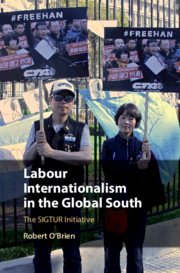
Robert O'Brien, Labour Internationalism in the Global South (Cambridge U Press)


O’Brien, Robert. 2019. Labour Internationalism in the Global South: The SIGTUR Initiative. Cambridge: Cambridge University Press.

Robert O'BrienMcMaster University, Ontario

New book: Labour Internationalism in the Global South

Labour Internationalism in the Global South

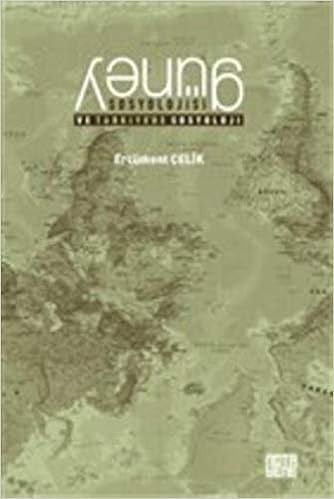
Ercüment Çelik, Güney Sosyolojisi ve Türkiye'de Sosyoloji (Southern Sociology and Sociology in Turkey)


Please find the book information below:

The rich contributions to the development of a Southern Sociology perspective have enabled sociologists in various countries to rethink and reassess the development of sociology discipline in their countries. This book firstly, aims to identify the main theses of the scholars contributed to the Southern Sociology perspective such as Connell, Burawoy, Comaroff and Comaroff, Bhambra, Rosa, Maia etc. and then applies these to the historical development of Turkish sociology. The author selectively focuses on two periods, the 1930s-1950s and the 1970s-1980s, which would, he believes, be a valuable contribution from Turkey to the ongoing development of Southern Sociology perspective. The former period was remarked by the re-establishment of sociology at the Turkish universities with the contribution of German migrant scholars, who had to escape from the nationalist-socialist regime in Germany at those years. This period exemplifies a continuity of the Eurocentric development of sociology that extends and partly challenges the periodization of the development of sociology by Connell. The latter period was remarked by the contribution of Turkish scholars and intelligentsia to the international debates on the “Asian Type of Mode of Production” and “Petty Commodity Production”, which in turn exemplifies a Southern production of knowledge and engages with Burawoy’s arguments on Southern Sociology. The book secondly, problematizes the hegemonic construction and structure of the discipline at Turkish universities and focuses on the teaching of ‘Contemporary Sociological Theory’ Courses. The author presents empirical findings of the content analysis of course syllabi and reading lists at 16 sociology departments and qualitative analysis of in-depth interviews with 14 sociologists teaching this course. Keywords: Asian Mode of Production, Petty Commodity Production, Contemporary Sociological Theory, Southern Sociology and Turkish Sociology